
Every year I watch the same thing happen. Somebody opens a blank document on November 1st with big enthusiasm and a word count goal, writes 2,500 words on day one, 1,800 on day two, 900 on day three, and nothing on day four. By the second week, the project is abandoned, and the writer inevitably feels guilty and disappointed in themself.
Enthusiasm is fuel, and it runs out on a fairly predictable schedule, usually around day four if you’re really lucky. So that’s as far as enthusiasm will get you. But the thing that helps you get through the rest of the month is going to be how well you prepared for it and whether you keep showing up even when it’s hard.
So if you're doing NaNoWriMo this year and you haven’t prepped yet, don’t fret. The week before can be worth more than any single writing day in November if you handle it right.
Start with planning out your first scene
Your first scene specifically is a far smaller job than planning out your whole book, but it can make a huge difference in your confidence levels.
You want to know, before November 1st: who is in it, what they want in that specific scene, what stops them getting it, and what they do about that. Four sentences can do the trick, but I encourage you to write down what you envision happening in it in as much detail as you want.
The reason this matters more than a full outline is that day one is where most of the false starts happen: you open the document knowing your premise, and then you accidentally discover that a premise is not a scene! Then you write six versions of the opening paragraph (none of which end up feeling right), and you go to bed having written 200 words and lost the day and the enthusiasm.
A first scene with a clear character voice and goal in it produces pages. So that’s what you’re looking for.
Think about that damn middle (more concretely than you want to)
The opening was planned, and the ending climax is vivid in your head, but the enormous saggy space between them is probably full of [exciting stuff happens here] and [they slowly progress grow closer] and [they face challenges].
Sure, sure, sure, that’s great. But do you know what those exciting beats and challenges are? Do you know how they challenge your characters? Do you know why? Do you know what consequences they leave?
You don’t need to map it scene by scene, but you should outline three or four things you know happen in it (and ideally they’re things that put pressure on your protagonist and change the course of the story rather than events that pass the time and affect nothing). It can be something they lose, something they find out, a choice they have to make with a cost attached, or a relationship that changes shape in a way they couldn’t anticipate!
It really helps to familiarise yourself with the concept of the midpoint and plan your story out from there. The midpoint of any story is that big change of course in the middle, where your story goes from having that smaller external goal your character starts with in the first act, to upping the stakes and revealing something bigger! Then the goal changes, the direction is different, we root for something new. Other plot beats click into place more easily once you’re set on your midpoint.
ALSO: A Pantser's Guide to Plotting
Build a parking lot
Somewhere in your document, or in a second file, keep a running list of problems you notice as you write, but you know you can’t solve them efficiently right that second, so that you can keep moving.
Notes like: Need to figure out the extra’s name. Need to check when the trains stop running. Chapter four feels flat, but I can’t figure out why yet.
Everything that would otherwise derail a session goes in the parking lot, and the draft keeps moving along. Half of these might solve themselves as you keep writing, and the ones that don't will work as very decent editorial notes to yourself for your next draft.
Don’t forget the logistics
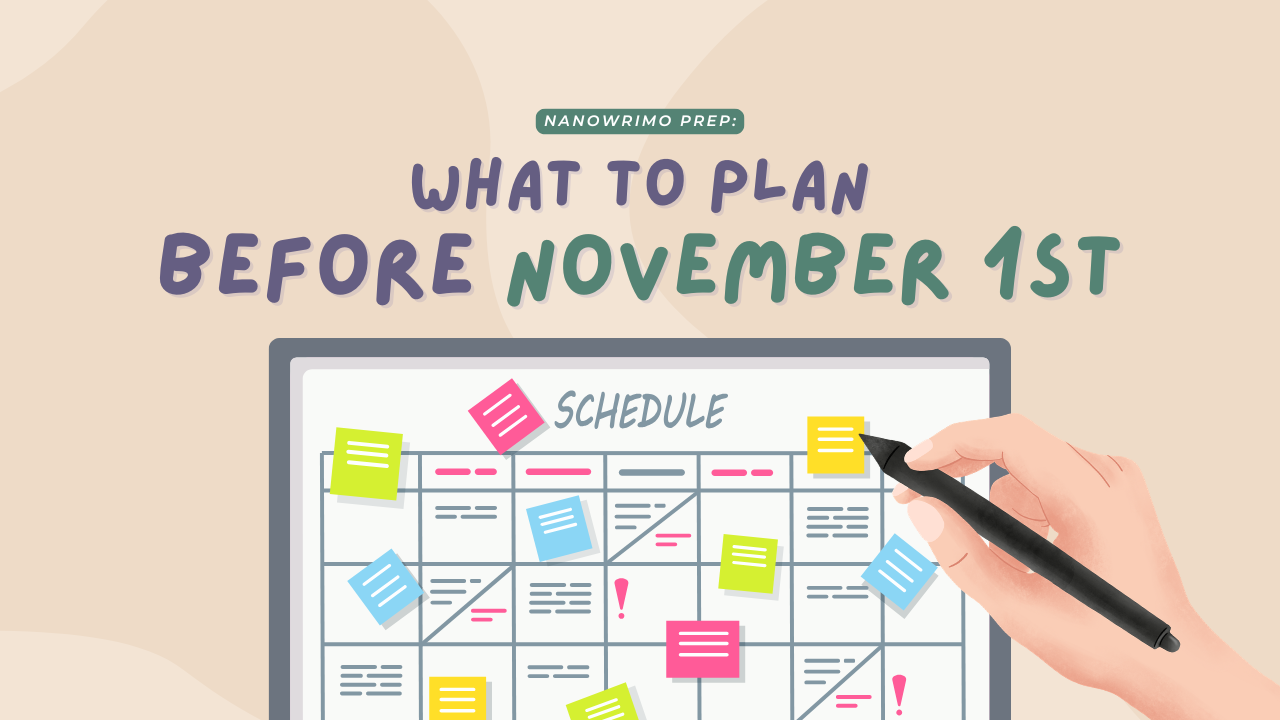
When are you going to write? Pick the specific window in your day and tell whoever else lives in your house. A vague intention to write every day loses to every other demand on your time.
Where are you writing? Every November, somebody loses several thousand words, and it is devastating every single time! Pick one writing dashboard, set it up thoroughly, and then don’t mess with it until the end of November.
What counts? Decide in advance whether notes, outlining, and rewritten scenes count towards your total or if you’re aiming only for raw word count in your draft.
What happens when you fall behind? You might at some point. Deciding in advance that you’ll carry on from the current day’s target rather than trying to make up a deficit could save the whole attempt, even if you end up writing 40k instead of 50k. That’s still much better than stopping completely at 20k because you fell behind.
If 50,000 words isn’t realistic for you…
Then don’t aim for 50,000. The number is arbitrary, and the value of the month is in building consistency rather than the total number of words you put down.
I’ve had coaching clients set 20,000 for November and finish elated, having built a habit that carried them through to March! I’ve watched others hit 50,000 and produce something so rushed that it was easier to start again than to revise it. Pick a number that doesn’t make it feel daunting to sit down tomorrow and write.
Write yourself a line at the top of the document: this draft can be bad because I will fix it in January. Give yourself a tangible appointment with your revision of whatever you write in November so the promise feels real and helps take that burden of perfection off you.
And if you’re not doing NaNoWriMo at all, everything above still works for any month you decide to draft in. Your book has no idea what month it is.
If you want the full version of this preparation, the kind that covers purpose, theme, character psychology and structure properly rather than in a week, that’s what Novel Plotting Academy is built for, and it comes in the Complete Novelist Bundle with Pro at Prose and Writer Unblocker.
FAQ
How do I prepare for NaNoWriMo?
Plan your first scene in detail, decide on three or four things that happen in the middle, agree with yourself in advance that the draft can be messy, and settle the practical questions of when and where you’ll write before November 1st.
Do I need a full outline to do NaNoWriMo?
No. A first scene you can start writing immediately and a handful of signposts for the middle are usually enough. Full outlines suit some writers and stall others, so use whichever amount of planning you’ll follow.
What should I do if I fall behind on my word count?
Carry on from the current day’s target rather than trying to clear the backlog. Chasing a large deficit is the most common reason writers abandon the month entirely.
Is 50,000 words in a month realistic?
It's about 1,667 words a day, which is achievable for some schedules and not others. A lower target you hit consistently builds a more useful habit than an ambitious one you abandon in week two.
What if I miss days during NaNoWriMo?
Missed days are normal and don’t end the attempt. Return at the next opportunity, write something small the same day to warm the story back up, and keep the target for the day you're in.